Leaf Sheep (Sea Slug)

It looks like a slug… but it acts like a plant! 🌱
Meet the Leaf Sheep (Costasiella kuroshimae), one of the tiniest and strangest animals in the ocean.
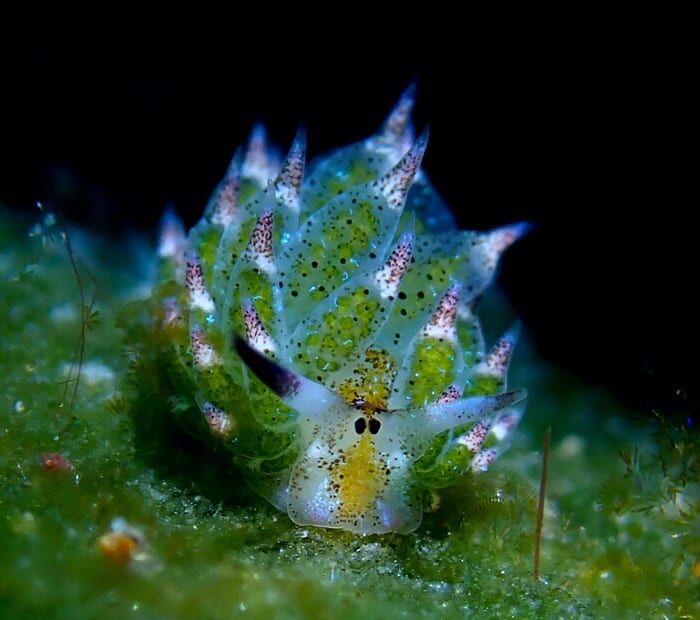
The Leaf Sheep is about the size of a grain of rice. It has cute white “ears,” shiny black eyes, and a back covered with little green shapes that look like leaves. 🍃
But guess what? Those aren’t leaves! They are called cerata.
When the Leaf Sheep eats algae, it steals tiny parts called chloroplasts. These help plants use sunlight to make energy. The Leaf Sheep keeps them and uses sunlight too! ☀️
This special trick is called kleptoplasty, and it makes the Leaf Sheep one of the only animals in the world that can photosynthesize.
Its green color helps it hide in seaweed, and sunlight helps power its body.
Living in warm ocean reefs, this tiny “sheep of the sea” munches on algae and floats happily along — running on sunshine! 🌊🐑✨

 ______________________________________________________________
Leaf Sheep Article
10 Leaf Sheep Facts [The Most Adorable Sea Slug]
Leaf sheep are so beautiful that they don’t seem real. Also known by their scientific name – Costasiella kuroshimae, they are actually a species of sea slug. Depending on whom you talk to, they’re also call them sea sheep, leaf slugs, and bunny slugs.
Here are some interesting facts about leaf sheep:

1. They are called leaf sheep, but they’re neither leaves nor sheep.
Leaf sheep are actually a species of sea slug. A term used commonly to describe marine invertebrates, sea slugs resemble terrestrial slugs. However, they come in a wide variety of shapes and colors. Sea slugs are closely related to gastropods, such as sea snails and mollusks, with the main difference being that they don’t have shells. Along with leaf sheep, nudibranchs are another species of sea slug.
2. What looks like sheep’s ears are actually scent and taste receptors.

Leaf sheep have rhinophores on their heads that look like the ears of a sheep in perspective to their faces. They also resemble antennae on insects. The leaf sheep’s rhinophores have fine hairs that sense chemicals in the water, enabling them to find food sources.
3. Leaf sheep are tiny.
Leaf sheep are only about a fourth of an inch, or a little over 5mm long. Yet, even at this size, their physical appearance is incredibly detailed. To some, they remind them of succulent plants, like aloe vera.
Here’s a video from Catrin Pichler that shows leaf sheep (Costasiella kuroshimae) in action, under the sea:
4. Their scientific name is a combination of Latin and Japanese.
Leaf sheep’s scientific name, Costasiella kuroshimae, is a combination or Latin and Japanese. Costasiella indicates the genus name of all sea slugs belonging to the sacoglossa group. They are also referred to as “sap-sucking sea slugs.” The kuroshimae part of the leaf sheep’s name comes from the Japanese island Kuroshima, which is off the coast of Taiwan. Kuroshima is known for its crystal clear waters and it’s where the leaf sheep was first discovered in 1993.
5. Leaf sheep are among the few sea creatures who can photosynthesize.

Although they are not plants, Costasiella kuroshimae exhibit one key plant-like characteristic: They can perform the process of photosynthesis, which is the process by which plants can use sunlight to create energy from carbon dioxide and water.
6. Like terrestrial sheep, leaf sheep are herbivores who “graze.”

As mentioned earlier, the primary diet of leaf sheep is sea algae. When they consume the algae, they retain the chloroplast, a plastid that contains chlorophyll. The chloroplast is then stored in their bodies and can be used for photosynthesis.
7. Leas sheep’s natural habitat expands beyond Japan.
Since they are a newly discovered species, the full extent of leaf sheep’s natural habitat is yet unknown. Thus far, we know they live on reefs off the coasts of Japan, the Philippines, and Indonesia.
8. We don’t know how long they live.
While some scientists believe that kleptoplasty can add to longevity in sacoglossans, the truth is – we don’t know how long leaf sheep live. For a species discovered less than three decades ago, we still have much to learn.
9. Leaf sheep should not be considered for pets.

Because they are so beautiful and adorable, many people wonder if they can have a leaf sheep as a pet. To begin, we simply don’t have enough information yet about leaf sheep to understand what keeps them fully thriving.
But more importantly, while they are adorable, leaf sheep are still wild animals who have the right to live in their natural habitats. The minute that a market is made for wild animals is the minute that they are suddenly viewed as property (which they are not) that can be bought, sold, and exploited.
If you care about leaf sheep, it’s a better call to support organizations that are focusing on protecting biodiversity in the world’s oceans, such as Oceana and the Coral Reef Alliance.
10. You can enjoy leaf sheep online.

If you’re a leaf sheep fan, you are not alone. These cute and beautiful creatures are beloved by many as their online presence attests. In fact, many people say they could be Pokémon. After all, they are cute, they have special powers, like performing photosynthesis, and they are from Japan.


Comments
Post a Comment